Showing posts with label music industry. Show all posts

6 May 2008

Variable Pricing...what the hell is it?

Warners Music Group are trying a new tactic to erase all memories of a torrid few years financially (just like the other majors) - something known as 'variable pricing'. A deal with Digonex Technologies, a company based in Indiana who have been pushing this idea for some time, will allow the major label to pilot a program for the albums it releases digitally. Details are a bit wishy-washy and it's not really known whether or not major artists on the label will take part. What is being promised though is that consumers will have an affect on the way albums are priced.

One question remains though - what is the true definition of variable pricing in this context? It basically means that the prices of songs/albums could change frequently dependent on consumer behaviours in order for the company to find what is being described as the 'sweet spot'. This includes things like how long the music has been available for, what the demand is for it and so forth. But even whilst typing this out, I keep thinking to myself 'this really isn't going to be that different from the way music is priced at the moment.'

Even though this is a very experimental idea and aspects of it could change, I don't think this could ever work in a mass retail sense. For one, iTunes, 7 Digital, Napster and so forth will not want to change their standard charges for albums, since they have their own principals when it comes to business. That and there's also the age old problem of stopping illegal downloaders, which it won't.

DIGG IT!

2 May 2008

Music Distribution Watch: The Cure

In the light of all these new ways of releasing music, Musical Chairs starts a new feature similar to what I discussed about a week or so ago.

THE CURE

What: Singles from the new album.

The deal: Singles from The Cure's upcoming album 13th will be released every month on the 13th, which seems logical, for four months until the untitled record comes out. These will sold in a physical format (through their store for definite - not sure if the big chains are taking part too at this moment in time) and a digital format.

Each release will include an a-side from the new album and a b-side that won't be featured. The frist two releases will be The Only One/NY Trip and Freakshow/All Kinds Of Stuff

Summary: A nice revival of the 'singles club' idea many years ago when vinyl was still all the rage. The problem is though that the whole thing does somewhat smell of some sort of gimmick on the part of the record label.

A good idea, but the operation is a bit too slick.

DIGG IT!

24 April 2008

Do NME readers play vinyl?

Honestly, it is a serious question.

In a couple of weeks time, Coldplay will be issueing a vinyl, in conjuction with hipster publication NME, of their first single from their upcoming fourth album, Viva La Vida or Death And All His Friends (Chris Martin isn't good at naming things is he?) called Violet Hill. A Spell A Rebel Yell will also be on it and is being promoted as an 'exclusive' track that won't be available anywhere else...so just an average B-side then. All joking aside, I'm a fan of the band and am intrigued as to what the new material is like.

NME are no stranger to free music giveaways. They gave away a remix CD of Bloc Party's one-off single Flux and a free download from The Verve rehearsals last year. They've also given away Babyshambles and White Stripes vinyls to their readers.

But do the readers of NME care for vinyl? Sure, it may look pretty and it's a nice collector's item, but I fear that most readers of the NME (who I deem to be mostly teenagers and students) don't actually own anything that resembles a device that plays records. I also find it deeply tragic that people in that target market don't make the effort to purchase a record player.

I think the idea behind NME's giveaway promotions are sound but vinyl isn't the way to go. It feels like wasted energy on their part. They should probably stick to mp3s, because that's down with the kids these day isn't it?

DIGG IT!

22 April 2008

Music distribution methods: What works and what doesn't?

It is now just over six months since Radiohead threw a curveball at the industry fat cats and released In Rainbows through their own site for download, inviting the customer to value their purchase. Since then, releasing music hasn't been the same. Many bands have tried their take on distributing their own work.

So, what methods work and what don't? What is there to be learned from the last half-year?

RADIOHEAD

What:
In Rainbows

The deal: You could purchase a digital copy the Oxford quintet's 7th album through their website. The consumer could also pick a price for their purchase of anything up to £100, so in theory, you could download it for nothing.

Also on offer was a 'discbox'. This contained the CD, a bonus CD of extra material, a vinyl copy of the main album, lyrics and exclusive artwork, all in one neatly packaged box.

Summary: This was the thing that kick-started the 'revolution', as the media likes to call it, and, whilst the idea was innovative and unique, it had people moaning about the inferior quality of the audio in comparison to other formats they could have released it in.

THE CHARLATANS

What:
You Cross My Path

The deal: The Charlatans teamed up with XFM to give away their 10th studio album for free. No cost whatsoever. Simple as.

Summary: This, whilst a gesture of great kindness to the fan, is not something I would call a 'sustainable strategy'. This is something that to me only works for tracks and singles.
NINE INCH NAILS

What:
Ghosts I-IV

The deal: Trent Reznor give customers no less than five purchase options for his new two-disc instrumental record. They were:

The first part of Ghosts for download at no cost.
All of Ghosts with artwork and all that jazz for $5.
The CD copy for $10.
A deluxe edition package, including multi-track DVD, Blu-Ray DVD and the CD copy for $75.
A limited edition set with all the above plus some autographed memorabilia for $300, which sold out instantly.

Summary: Trent Reznor is a smart man and knows that customers want choice. This method is one that is an all-around winner and is helped by the quality and presentation of Ghosts I-IV. Shame that the shipping costs are so damn expensive.

THE RACONTEURS

What:
Consolers Of The Lonely

The deal: Perhaps the strategy closest to conventional release methods, the Detroit band chose to announce their new album worldwide a week later to avoid leaks. It was available in all formats.

Summary: It worked to an extent but, despite the grumblings of Mr Jack White, the record still leaked a hefty five days early. That and the worldwide release didn't work fully. A brave attempt but a failed attempt.

So, here are some quick-fire dos and don'ts.

DO release your album as soon as announced.
DON'T as Trent Reznor would say, "get caught with your pants down," and get a server that will crash on the first day due to demand.
DO value your music wisely.
DON'T add insane shipping costs.
DON'T allow gaps between announcement and release. These things do leak fast. Really fast.
DO give the customer choice.
DON'T exclude CDs and vinyls. People still dig those formats as much as mp3s.

Of course, this only applies to rock bands with money. New bands may wish to avoid this...

DIGG IT!

20 April 2008

Record Store Day

Yesterday, a group of very small, independent record shops joined forces to organise something called Record Store Day. This was supported by many artists and musicians including Damon Albarn, Regina Spektor, Amanda Palmer and Paul McCartney to name but a few. In an age where there are big chains selling music for rip-off prices (HMV, Zavvi etc) and where you can also download tracks with the click of a button - legally AND illegally - these businesses are dying. It's quite a sad reality.

Record shops are good for two reasons. The first, and perhaps most important, is the stuff you can buy in them. Because these stores have such a mass array of random CDs and vinyls makes them look like even more a treasure trove. Last week whilst scouring Camden I stumbled across Swim by Feeder on vinyl. There's just nowhere else I would expect to find such a rarity. They also tend to price things a lot cheaper than big brands. I got Wish You Were Here by Pink Floyd for £4 last year and a copy of a Nine Inch Nails CD single called Sin, released originally in 1990, for £5. Even eBay sellers don't sell these at such a generously low amount.

The second reason is the people who actually own them. It seems almost a cliche that these people are music nerds who do Top 5 lists similar to those in High Fidelity, but they are incredibly brainy and their knowledge is valuable. The person who owns Ben's, my local record shop in Guildford, called...erm, Ben, was the one who first pointed me in the direction of the epic pop of Scott Walker, through hearing something being played on the store PA (I had first heard of the tune through a Divine Comedy cover - it might have been Jackie).

So whatever your tastes, make a trip to your local record shop every now and again. They need your money to stay alive, and in return they will offer you some amazing musical treasures.

DIGG IT!

3 March 2008

Nine Inch Nails album released

Trent Reznor has released a double album under the Nine Inch Nails guise, entitled Ghosts. I'm sure you've heard a lot about it right now. If not, then this link should explain it perfectly.

It seems like he wants to learn from his experience with the Saul Williams download and add more options. This sounds like an album that would be awesome to keep on CD, so I'm glad it's being offered this time. A shame that to get the vinyl I have to also buy a Blu-Ray disc, which I don't need. Oh well.

A full review of Ghosts will be up soon when I get the chance to listen it (or should that be download it, haha). I do urge you to buy the download at least and not be cheap, because Trent Reznor deserves it.

Download Ghosts

DIGG IT!

27 February 2008

Guy Hands: The saviour of EMI?

Today I had a chance to read an article on Rolling Stone's website, for some reason dated into the future (6th March 2008). It was a brief one about the plans that Guy Hands has up his sleeve for EMI. Many people were very critical of him for taking charge of a business in an industry he knows very little about and some wondered whether EMI would just collapse under his leadership.

I'm starting to think he is going to prove his doubters wrong in parts.

I think his ideas for the future of EMI make rather good business sense. When a company like EMI is losing millions upon millions of dollars then you have to cut the crap essentially. Marketing that wasn't needed HAS to be cut down. Salaries HAVE to be cut. Artists who under perform, no matter how good they are, HAVE to be let go.

However, he still has some flaws in his plan. I think the idea of continuing re-hashing former glories like The Beatles and Radiohead as plain dumb. That and I've never been keen on the idea of having corporate sponsors putting their brand on music.

I think he's headling along the right lines and if he can get rid of the plans mentioned above, then he has the potential to make EMI a formidable force in the industry once more. But it's going to take A LOT of work.

DIGG IT!

24 January 2008

Last FM goes OD


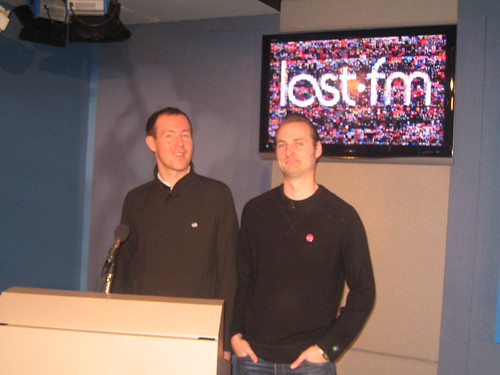
Last FM, a social networking site that allows you to see what other people are listening to and offers radio and streaming services based on that user's tastes and other features, have announced that they have gone on-demand. They managed to sign a deal with all the four big labels (EMI, Sony BMG, Warners, and Universal) and with hundreds of smaller independent labels to allow huge volumes of albums to be listened to and streamed, making Last FM bigger than Napster and all other leading competition.

In my eyes, this is a major deal. Especially considering the state of the industry where artists and organisations are desperately trying to find new business models. This one, to me, is the fairest model for both consumers and artists/labels so far.

So how will this work then?

The user of Last FM would be at first allowed to listen to any track from the library of 3.5 million tracks for free...but there is a catch. You can allow listen to the track for a maximum of three times. After that, you will be recommended other songs or artists that you may like and will advise you to subscribe, like Napster, in order to have unlimited listens. I'm unsure of what the fee is at the moment. I read one blog that said $3 but I'm not sure, since there's no mention in the Last FM blog post explaining the on-demand service. I'm pretty sure though it will be cheaper than Napster.

What's the benefit for the artists and labels?

It's simple really. They will be paid everytime a song gets played. Last FM also annoucnced that, in addition to this on-demand service, unsigned artists could sign up for free and upload their own music to the database. That artist would then recieve a royalties payment everytime one of their tracks was played. This aspect of the on-demand service is really exciting for aspiring artists. The benefits for an unsigned artist are now far more appealling financially than they would be on MySpace.

How will Last FM make money?

Advertisers would be able to use a 'mini billboard' in the pop up player to sell their product or service. Simple as.

This idea is definitely one that can work and I think the oppurtunities for unsigned artists are promosing. Is this the way forward for the music industry? Well, unless anyone has a better idea, this is the best solution I've heard of so far...

DIGG IT!

26 October 2007

NIN and Saul Williams 'do a Radiohead'

Yesterday churned out another relatively interesting development in this 'free music for all' period. Saul Williams, whose album was produced and mixed by Trent Reznor of Nine Inch Nails, is releasing a new album in a similar way to Radiohead.

Trent posted a message on Nine Inch Nail's official website yesterday explaining the details of the release. Like the release of 'In Rainbows' by Radiohead, fans can pre-order the album 'Niggy Tardust' for download on November 1st.

But where it differs to the way that Radiohead did business is in the pricing. There are two purchase options. If you choose to download it for free, you will get the album in a basic 192kbps mp3 format. However, if you choose to 'support the artist directly' by paying $5 (I think that is just over £2 in UK money), you have a choice to download it in 192kbps mp3 form, 320kbps mp3 form or a FLAC lossless audio.

It's a neat progression on what was already a good idea by Radiohead. As Trent said in his blog post, if you can't be arsed to read the link:

I feel we've improved upon their idea in a few profound ways that benefit you, the consumer. You obviously will be the judge of this in the end. One thing that IS very different in our situation is that Saul's not the household name (yet!) that Radiohead is, and that means we need your support on this more than ever. If you like what you hear, spread the word.

I am not totally unfamiliar with Saul Williams. The first I heard of him was when he released 'List Of Demands' as a single back in 2005. I do know that he and Trent have a very solid working partnership. Saul has supported Nine Inch Nails and even performed tracks with Trent's band whilst on tour with them. He also did backing vocals for 'Survivalism', which was the lead single of 'Year Zero'.

One thing that is for sure though is that this is yet another exciting evolution of this so-called 'new business model' - of which Alan McGee, one of the key figures in the Britpop era, is a very big supporter of. I can imagine these kind of things, along with The Verve's releasing of a demo track (which I reviewed yesterday) to constantly evolve as the weeks go by.

In short, it's quite an exciting time for the music industry - as corny as it sounds.

I found this article written a few weeks by a blogger called Maki. Even though her blog isn't music based (it is based on making money through online ventures), it a very comprehensive and detailed analysis of ways that bands are defying the major labels. Well worth a read if you have ten/fifteen minutes to spare, if you can ignore the Radiohead fangirl approach at the start!

DIGG IT!